
Christmas stamps come out every year without fail. Ask what the equivalent is for the other federal holidays and the answer turns out to be uneven — some have a dedicated issue, some borrow one, and several have never had one at all.
Going through them in calendar order, with the actual stamp in each case.
New Year's Day — no stamp
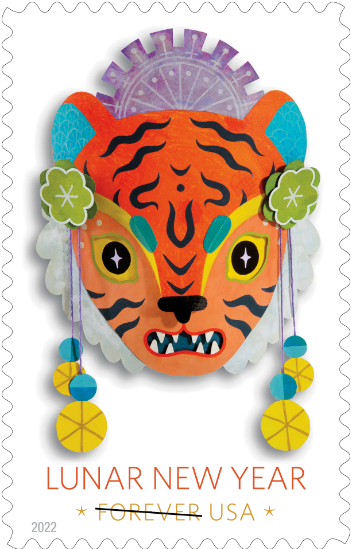
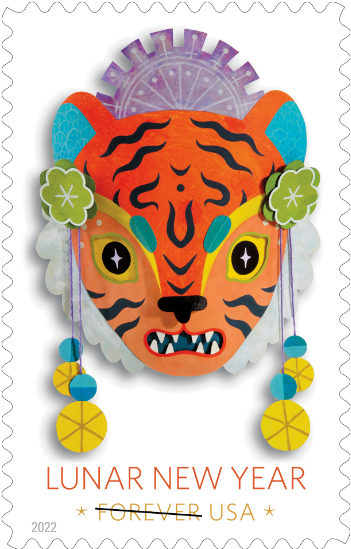
There has never been a US New Year's Day stamp. What people reach for instead is the Lunar New Year series — the Year of the Tiger issue came out in January, as a Forever stamp in panes of 20.
Worth being clear that these are different occasions. Lunar New Year falls in late January or February and marks a different calendar entirely; it is not the federal holiday on 1 January. It is simply the nearest thing to a New Year stamp that exists.
Martin Luther King Jr. Day — yes
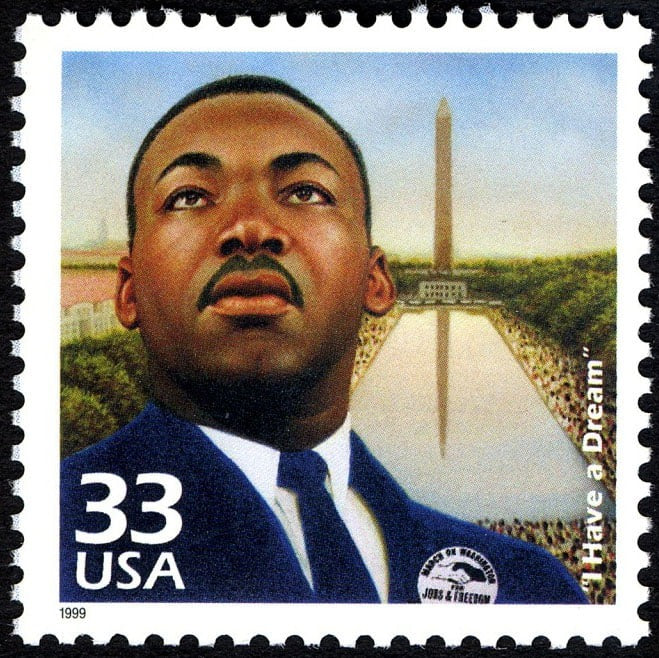
The holiday falls on the third Monday in January. King has appeared on two US stamps and anchors a ten-stamp block on the civil rights movement.
His first was issued 13 January 1979, as the second design in the then-new Black Heritage series — a year after the Harriet Tubman commemorative that launched it. Second in a series that has since run for decades.
One general note that applies from here down: since 2011, new commemoratives at the one-ounce First-Class rate have been issued as Forever stamps. Anything older carries a printed denomination and needs make-up postage.
Presidents Day — no dedicated stamp
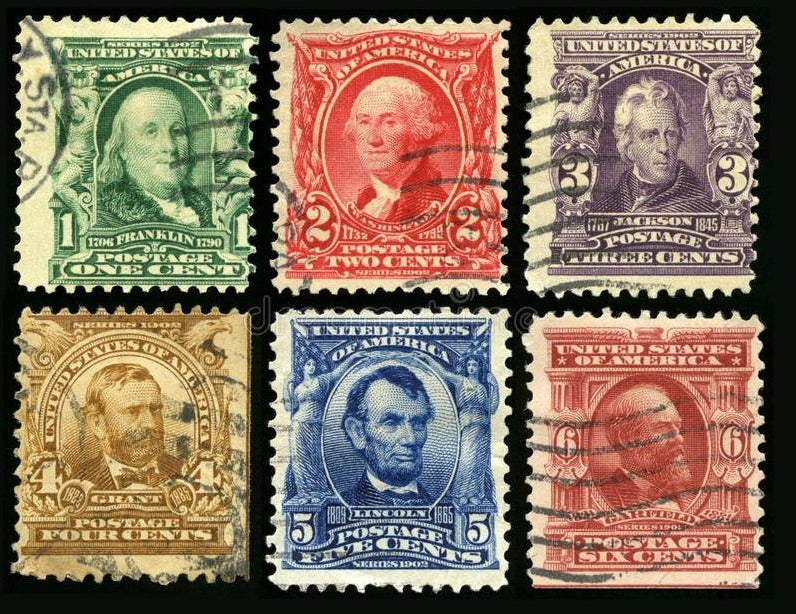
There is no Presidents Day issue. There has never needed to be, because presidents have been on US stamps from the beginning.
The Post Office's first two stamps, in 1847, carried George Washington and Benjamin Franklin. Since then Jefferson, Jackson, Lincoln and others have appeared repeatedly, mostly as definitives rather than commemoratives — the everyday stamps, not the special ones.
A small correction to a claim that circulates with that pairing: Franklin was never president. He is on the first stamp as the first Postmaster General, which is a better reason. An 1847 block of sixteen Franklins is among the most valuable US philatelic items in existence.
USPS also observes a rule here that catches people out: living people do not go on US stamps.
Memorial Day — yes
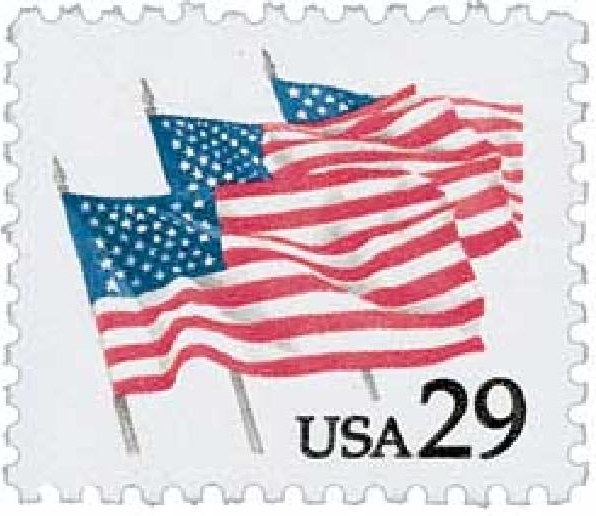
The 29-cent Flags on Parade stamp, issued 30 May 1991 in Waterloo, New York — the village that held the first Memorial Day in 1866 for its own Civil War dead, and the 125th anniversary of that occasion.
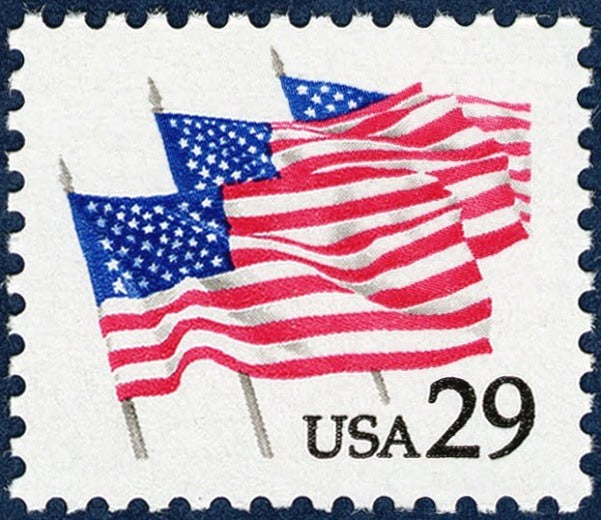
The design went through a revealing change. It started as three flags waving; the designers turned them so the three appear to be passing by, as in a parade. The stamp itself carries no anniversary text — the first-day ceremony and the Waterloo postmark were considered tribute enough.
Independence Day — many
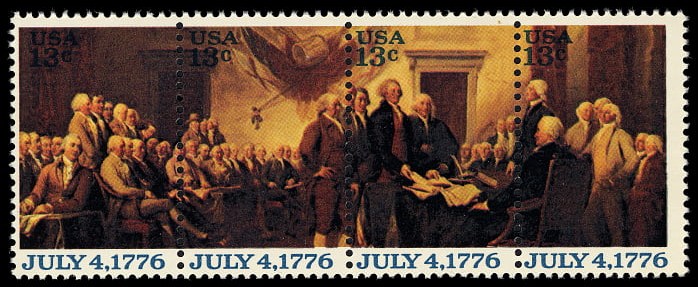
The best-served holiday on the list.
The first came in 1869, nearly ninety-three years after the Declaration, showing the signing scene reduced to its principal figures.
In 1926, a 2-cent stamp marked the Sesquicentennial International Exposition in Philadelphia — the 150th anniversary of the signing. You will see that exposition's name mangled in a lot of places; sesquicentennial simply means one hundred and fifty years.
Two more followed in 1959 and 1960, both at 4 cents, similar in design, both with 11 perforations.
Then the big one. On 4 July 1976, the bicentennial, USPS issued a 13-cent Declaration of Independence design printed as a single continuous image running across four stamps (Scott 1691–1694). Designed by Vincent E. Hoffman from John Trumbull's painting — the first of the works Trumbull completed for the Capitol Rotunda.
Labor Day — yes
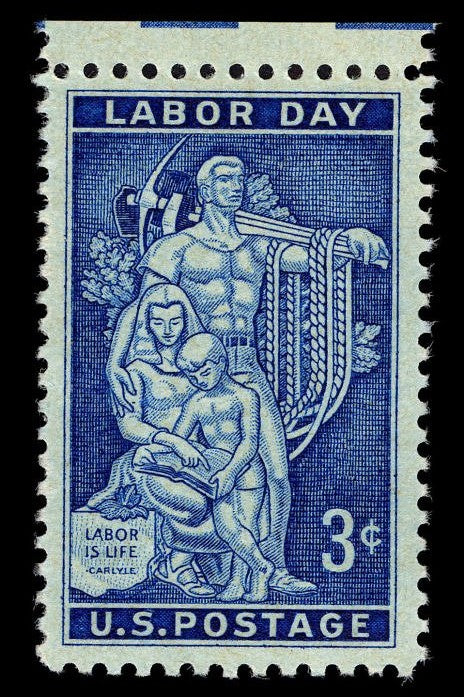
A commemorative honouring American workers, issued 3 September 1956 in Camden, New Jersey.
Columbus Day — sort of
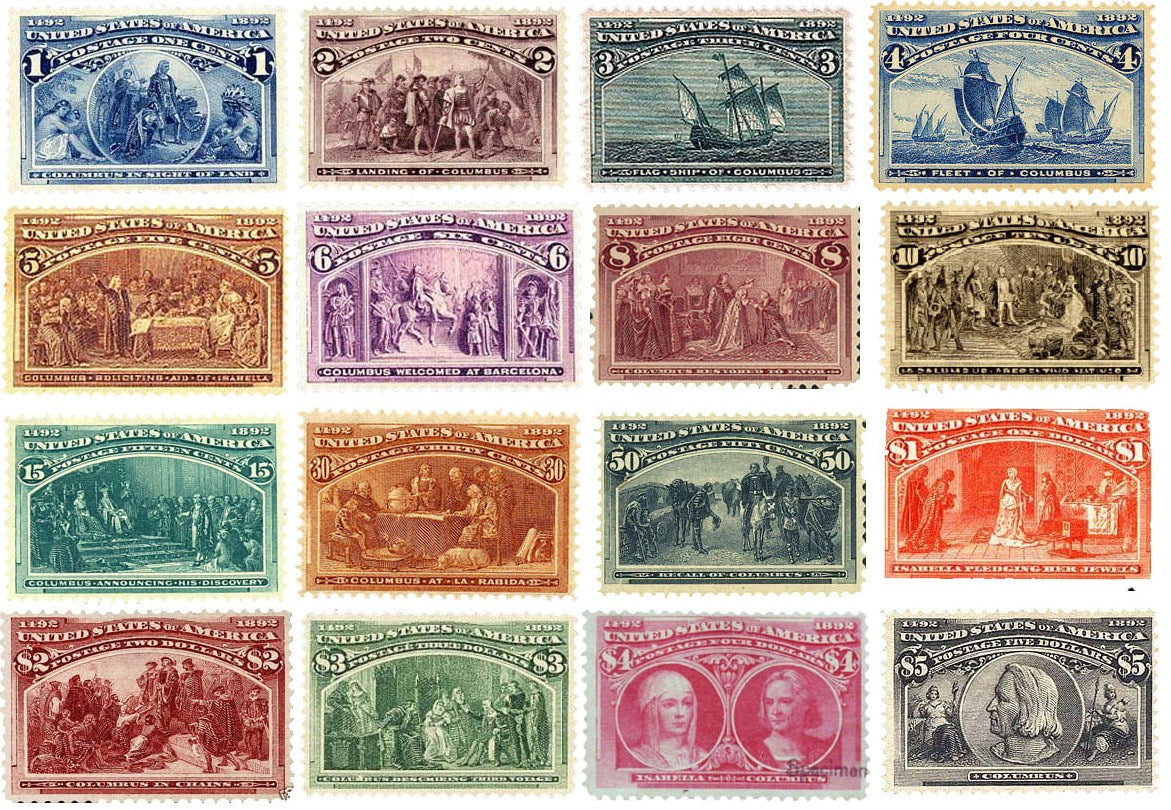
Columbus made landfall in the Americas on 12 October 1492. The stamps associated with him are not holiday stamps at all — the Columbian Issue was produced for the World's Columbian Exposition held in Chicago in 1893.
Sixteen stamps running from 1¢ to $5, each engraved with an episode from Columbus's career. These are the first US commemorative stamps ever issued, which makes the set historically important quite apart from its subject.
Veterans Day — yes, and it is not the Memorial Day stamp
Worth separating, because the two get confused constantly. The Flags on Parade stamp above is a Memorial Day issue. Veterans Day has its own.
The Medal of Honor stamps were issued on 11 November 2013 in a format new at the time — the Prestige Folio. Each "Medal of Honor: World War II" folio holds 20 Forever stamps, worth the current one-ounce rate whenever used.
Thanksgiving — yes
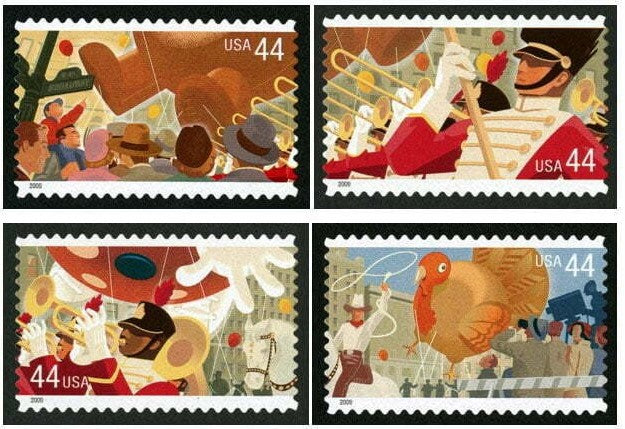
Four stamps issued 9 September 2009 for the Macy's Thanksgiving Day Parade: the crowd, the musicians, the turkey balloon, the drum major. Each works alone, and set side by side they form one continuous parade scene.
The holiday's own history is more contested than the stamps suggest. Settlers in Massachusetts survived the winter of 1621 with help from Native people who taught them to catch eel and grow corn. In 1863, in the middle of the Civil War, Lincoln proclaimed on 3 October that the last Thursday in November be observed as Thanksgiving — with particular thought for those who had lost family in the fighting. The first under that proclamation was 26 November that year.
It stayed on the last Thursday until 1939, when Franklin Roosevelt moved it a week earlier to lengthen the retail season during the Depression. The reaction was hostile enough to earn the name Franksgiving, and two years later he signed a law fixing it on the fourth Thursday, where it has stayed.
Christmas — every year
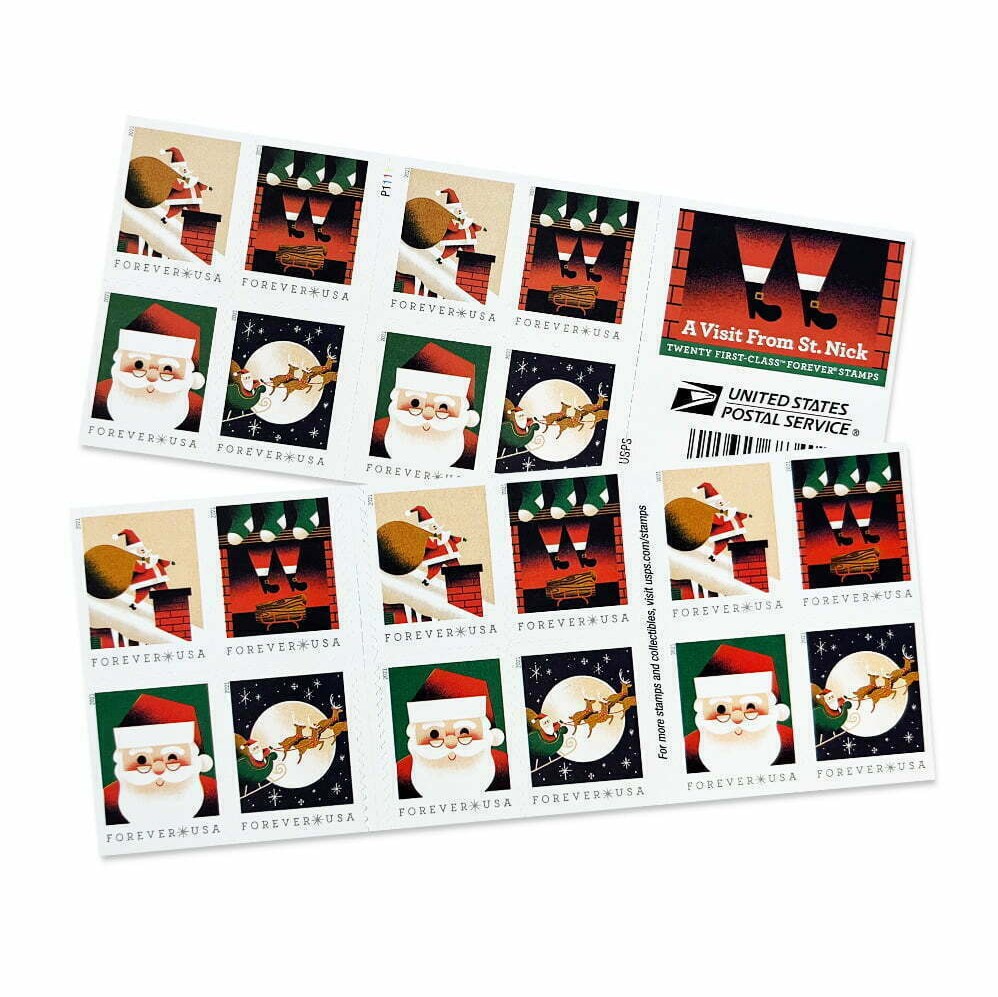
The first US Christmas stamp was issued on 1 November 1962 in Pittsburgh. Since then it has been the one guaranteed annual seasonal issue, split between religious designs and secular ones — trees, wreaths, Santa.
These print in enormous quantities to carry the card season, which is why almost any Christmas stamp is cheap and easy to find. For collectors the difficulty is not the stamp but the cover: a Christmas postmark from the right place. Christmas Island, Christmas in Florida, North Pole in Alaska, North Pole in New York, Santa in Indiana.
The holiday that is missing
Lists of federal holidays put together a few years ago give ten. There are eleven — Juneteenth National Independence Day, on 19 June, was added and is absent from most of the older tables still circulating.
If you are working from a holiday list to plan mail, check it includes Juneteenth. Post offices are closed and there is no delivery, and an old list will not tell you that.
Best deals on Forever stamps
Only the recent issues here are practical postage — the 2013 Medal of Honor folio, current Christmas and Lunar New Year issues, and anything else from 2011 onward. Those are Forever stamps and turn up below face on the surplus market once retired. The older denominated issues are collectors' items that happen to still be valid with make-up postage.
Where to buy
Current issues from USPS. Retired seasonal designs from a verified surplus channel such as Forever Stamp Center — see the holiday range.
The short version
New Year's Day and Presidents Day have no stamp of their own. Veterans Day has the Medal of Honor issue, not the Memorial Day flags. Columbus Day's stamps were made for an exposition, not a holiday. Christmas is the only one that comes round annually — and the federal list now has eleven holidays, not ten.
More on buying Forever stamps
- 👉 USPS Issues Two Kinds of Christmas Stamp Every Year
- 👉 Four Halloween Stamps, and That Is the Whole List
- 👉 You Have to Be Dead to Get on a US Stamp

USPS specialist based in Los Angeles with extensive experience in postal operations and customer service. Certified in mail management and trained at the USPS Business Mail Academy, she offers reliable guidance on Forever Stamps and practical mailing solutions.
