
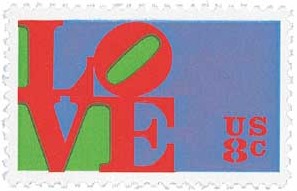
USPS has issued Love stamps since 1973. What gets lost in the category listings is that these were commissioned from named artists — a pop artist, a nun, a graphic designer from advertising — and knowing who made which one changes how the early series reads.
William Gicker, the Postal Service's manager of stamp development, has described the approach directly: stamps as "miniature works of art." The first two decades of the Love series are the clearest evidence for that claim.
1973 — Robert Indiana
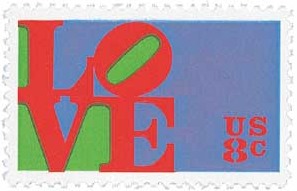
The first one, from the American pop artist whose stacked LOVE lettering — with its tilted V — was already among the most recognisable images in the country.
It was unveiled in Philadelphia, the City of Brotherly Love, which is the sort of choice USPS makes deliberately. Issued for weddings and valentines, and it started everything that followed.
1982 — Mary Faulconer
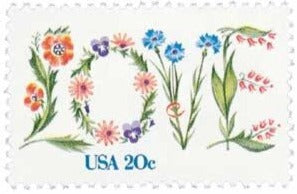
Nine years passed before the second one. The 20c Love Flowers came out in 1982 in response to public demand for a new Love stamp — designed by Mary Faulconer of New York City and unveiled in Boston.
Faulconer moved the series away from typography and towards flowers, which is where it has largely stayed.
1984 — Bradbury Thompson
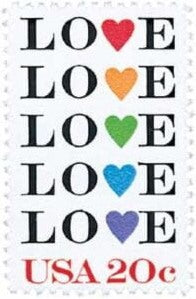
Love with Hearts, at 20c, unveiled in Washington DC. Thompson took Indiana's lettering and swapped the tilted V for a heart — a direct answer to the original design eleven years on.
Thompson oversaw the Love series from its start, which makes this the one entry where the series' art director designed the stamp himself.
1985 — Sister Corita Kent
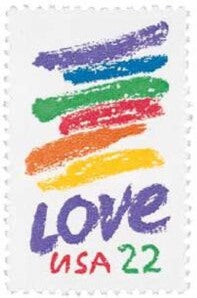
Love Crayon, 22c, issued 17 April 1985 and unveiled in Hollywood. Corita Kent was a nun and a printmaker whose bright, hand-lettered serigraphs are unlike anything else in the postal catalogue.
This was also the first Love stamp released after Valentine's Day. USPS reasoned the design worked year round — which quietly redefined what the series was for.
1986 — Saul Mandel
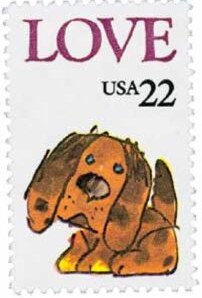
A 22c puppy, issued 30 January 1986 in New York, from an illustrator and animator who came out of advertising. Bright-eyed, floppy-eared, and impossible to read as anything but affection — Charles Schulz's "Happiness is a warm puppy," rendered as postage.
1987 — Hearts and Flowers
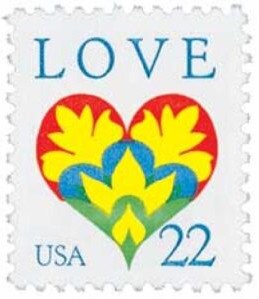
The sixth in the series, 22c, issued 30 January 1987 in San Francisco. The notable thing is physical: it is smaller than the large Love commemoratives that came before it.
1988 — Richard Sheaff, and the change that mattered
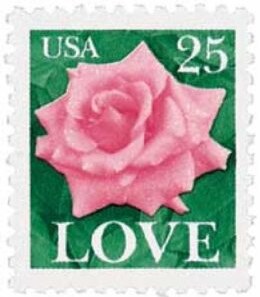
This is the structurally important year. Sheaff designed the first Love set with a second denomination for the heavier rate, aimed squarely at wedding invitations.
The 25¢ Pink Rose was issued 4 July 1988 in Pasadena. The 45¢ Pink and Yellow Roses followed on 8 July 1988 in Shreveport, Louisiana, for heavier invitations and oversized greeting cards.
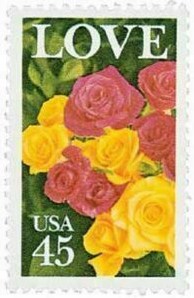
Every wedding-stamp pairing since works this way — a letter-rate design for the reply envelope and a heavier one for the invitation. It started here.
By this point the Love series was being printed in larger quantities, and kept in print longer, than any other regular US commemorative.
1990 — Jane Hertko
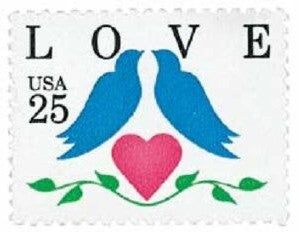
Love Birds, 25c, the ninth issue and the first Love stamp produced in both sheet and booklet form. A format change rather than an artistic one, and it made the stamps far easier to buy in the quantity a wedding needs.
1991 — the world intrudes
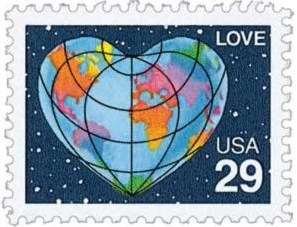
The 29-cent issue shows the Earth in the shape of a heart. It appeared during the war in the Persian Gulf, and the reading is not subtle — a Love stamp about the world rather than about a couple.
It is the only time the series has answered a news event, and it is the reason this one is worth having.
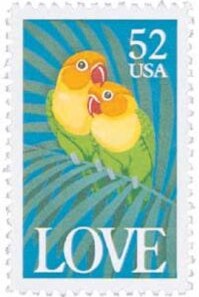
Its companion at 52 cents, for the heavier rate, is a pair of Fisher's lovebirds on a palm frond — following the two-denomination pattern Sheaff established.
Best deals on Forever stamps
Everything above predates the Forever stamp, so these carry printed denominations and need making up to today's rate — collectible rather than practical postage. Love issues from the Forever era onward are different: full postage at the current rate, and available below face on the surplus market once they leave official sale.
Where to buy
Current issues from USPS. Retired Love designs from a verified surplus channel such as Forever Stamp Center — see the love and wedding range.
The short version
Robert Indiana started it in 1973. Bradbury Thompson answered him in 1984 by replacing the V with a heart. Corita Kent made it a year-round stamp in 1985, and Richard Sheaff made it a wedding product in 1988 by adding a second denomination. That last decision still shapes how wedding postage is sold.
More on buying Forever stamps
- 👉 Roses on Love Stamps, 1988 to 2015
- 👉 The Love Stamp From the Year You Met
- 👉 The Two-Ounce Stamp Exists Because of Weddings

USPS specialist based in Los Angeles with extensive experience in postal operations and customer service. Certified in mail management and trained at the USPS Business Mail Academy, she offers reliable guidance on Forever Stamps and practical mailing solutions.
