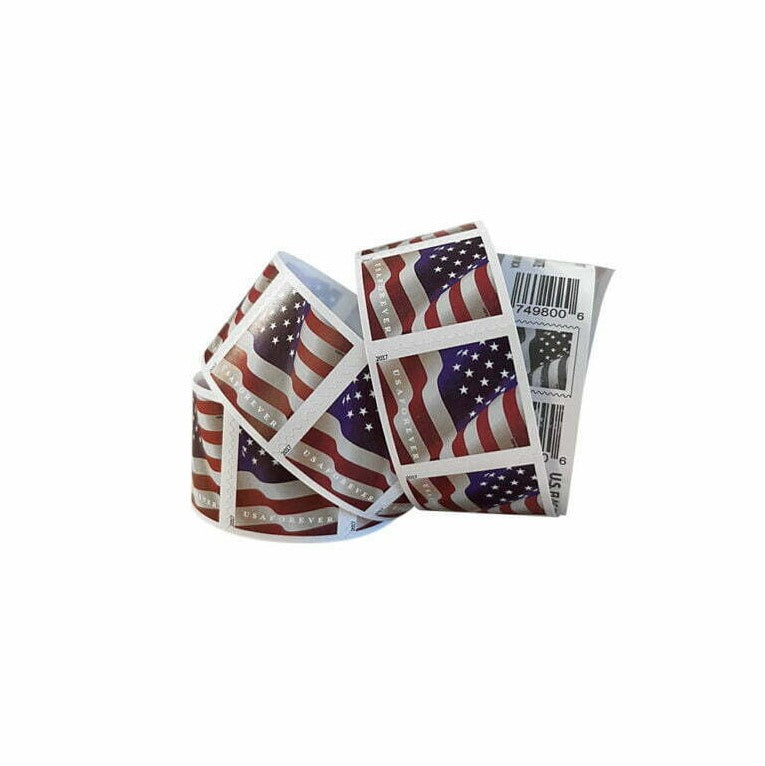
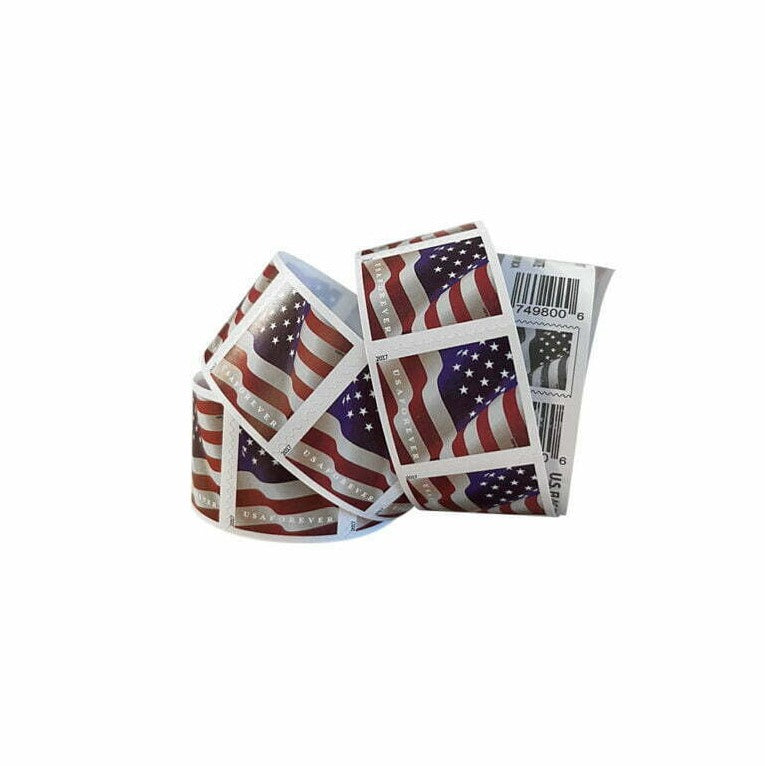
The US flag stamp is the most-printed, most-bought, most-used stamp in the country. It is also the one counterfeiters copy, and those two facts are the same fact.
Forgers do not target rare issues. They target the stamp that moves in volume, where a fake blends into a stack of a hundred and nobody looks twice. That is the flag.
Which makes it worth knowing what the real ones look like — and worth understanding why this design, out of everything USPS prints, became the default.
Why the flag became the default stamp
Because it is the only subject that never dates, never needs a justification, and never offends a customer. Commemoratives celebrate a person, a film, a species, a state. Somebody always has an opinion. The flag is the safe reissue, so USPS returns to it almost every year, and the printing runs dwarf anything else.
That ubiquity is the appeal for legitimate buyers too. Nobody reads anything into a flag stamp on an envelope. It works for a condolence card and an invoice equally.
What the flag on the stamp actually is
Thirteen horizontal stripes, red alternating with white. A blue canton in the upper left carrying 50 white five-pointed stars in nine offset rows. The stars are the states; the stripes are the thirteen colonies that became the first states.
The colours have names — White, Old Glory Blue, Old Glory Red — and readings that come down from the Great Seal: red for hardiness and valour, white for purity and innocence, blue for vigilance, perseverance and justice.
A short history, because it explains the design
On 1 January 1776, during the siege of British-held Boston, the Continental Army raised a flag over Prospect Hill: thirteen red and white stripes with the British Union Jack still in the corner. The Grand Union flag — the first to stand for the thing that was becoming a country, while still carrying the mark of the one it was leaving.
The Continental Congress replaced the corner on 14 June 1777, resolving that the flag carry thirteen stripes, red and white, and that the union be thirteen white stars in a blue field, "representing a new constellation." Everything since has been the same design with stars added.
14 June became Flag Day, formally, when President Harry S. Truman signed it into law in 1949 — nearly two centuries after the resolution it commemorates.
The flag was not always everywhere
This is the part most people get wrong. Before the Civil War the flag was scarce in ordinary life — government buildings, ships, military forts, and not much else. The Army did not carry it into battle during the War of Independence or the War of 1812; regiments carried their own colours, and the Stars and Stripes was largely a naval ensign.
That changed in 1861. After the shots at Fort Sumter the flag went north with the Union troops and through northern cities, and what followed was called flagmania — flags on houses, in windows, on lapels, and sales climbing accordingly.
The flag as a domestic object, hung outside an ordinary house, is a Civil War invention. Which is roughly when postage stamps were becoming an ordinary object too.
Telling the issues apart
Useful for collecting and useful for spotting something wrong. The recent flag issues are visually distinct if you know what to look for:
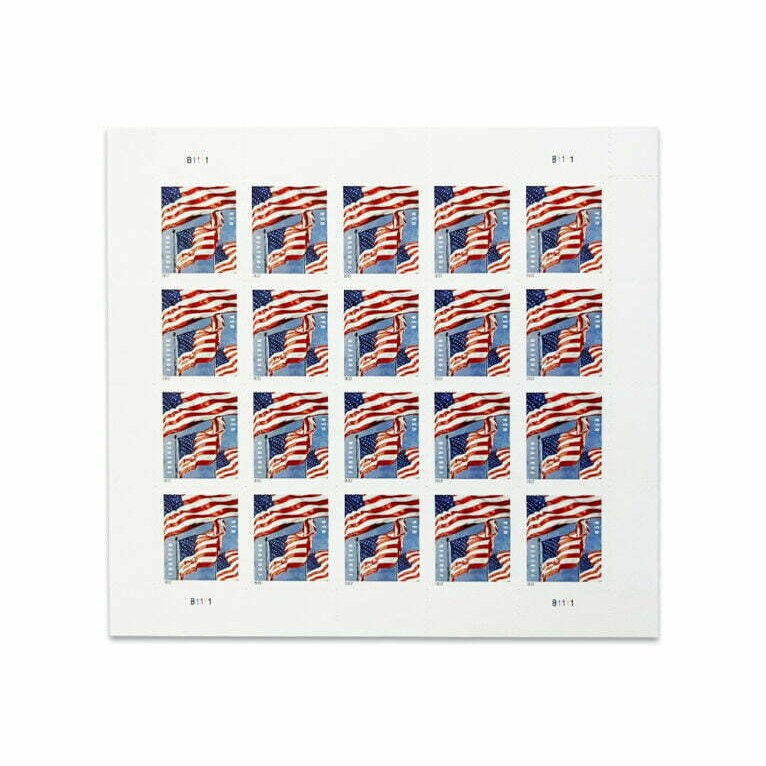
2017 — a tight photographic close-up, the flag rippling in a breeze, high detail in the fabric.
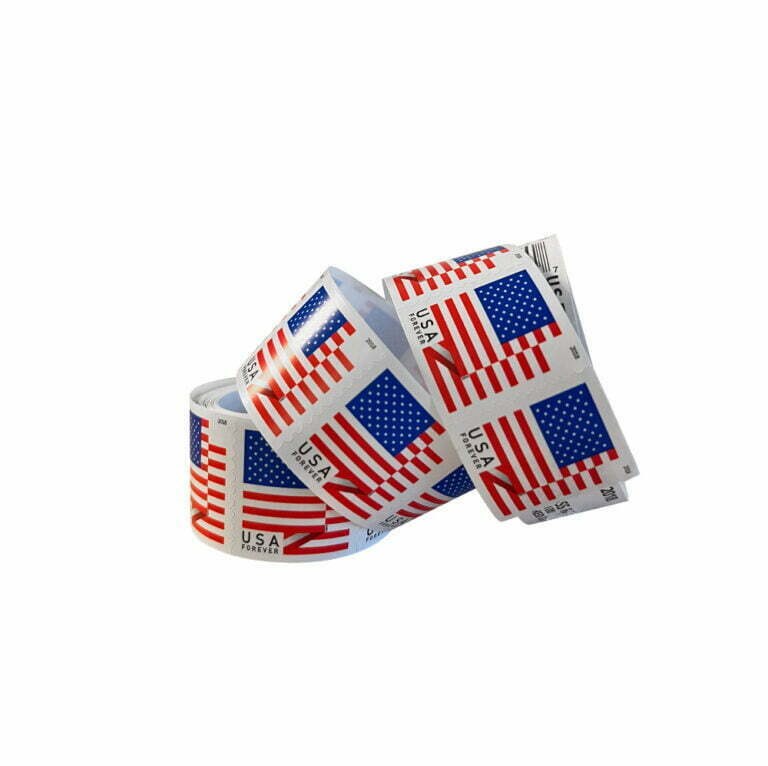
2018 — a sharp break from the photographic approach. Graphic and flattened, built around two crisp folds, shot from a low angle so the flag reads upward against the sky.
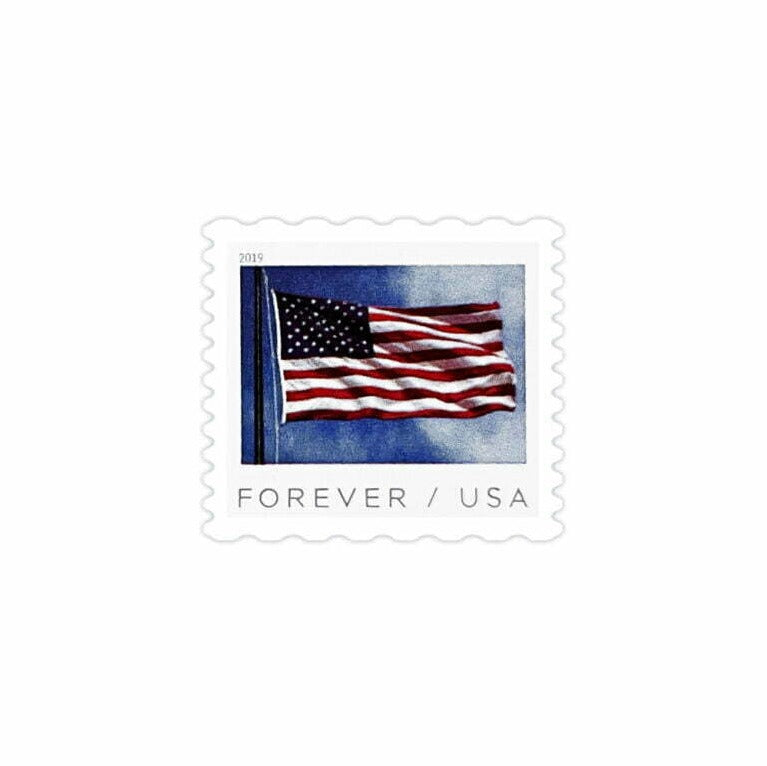
2019 — back to photography: one of the flags on the flagpoles at the far end of Chicago's Navy Pier, caught in a May wind.
2022 — billowing flag, the usual treatment, issued as a Forever stamp like all of them.
What this means for buying
Flag stamps are the highest-volume stamp and therefore the highest-risk purchase from an unverified seller. The counterfeits are usually competent at arm's length and wrong up close — perforation that is cut rather than punched, colour that is a shade off, paper that feels wrong in a stack.
The practical defences: buy from a seller that can say where stock came from, be suspicious of a discount that is too deep to be real, and compare a sheet against a known-good one before you use a hundred of them. A counterfeit is not just wasted money — it is postage due on every letter you sent.
Best deals on Forever stamps
Flag issues are Forever stamps: bought at one rate, valid at the next. Because they print in such quantity, surplus flag stock is the most reliably available below face value of anything in the catalogue — which is exactly why the offers that are too good to be true cluster here too.
Where to buy
Current issues from USPS. Retired issues and volume from a verified surplus channel such as Forever Stamp Center at www.foreverstampcenter.com. Background worth reading: the Smithsonian's evolution of the American flag, and the USPS announcements for the 2019 and 2022 issues.
The short version
The flag stamp is the default because the design cannot go out of date and cannot annoy anyone. It is the most counterfeited stamp for the same reason. Learn what the real issues look like, and buy from someone who can account for their stock.
More on buying Forever stamps
- 👉 Why the Flag Stamp Is the One You Should Default To
- 👉 Flag Stamps Won't Make You Money. Buy Them for Other Reasons.
- 👉 Buying Forever Stamps in Bulk Online

USPS specialist based in Los Angeles with extensive experience in postal operations and customer service. Certified in mail management and trained at the USPS Business Mail Academy, she offers reliable guidance on Forever Stamps and practical mailing solutions.
