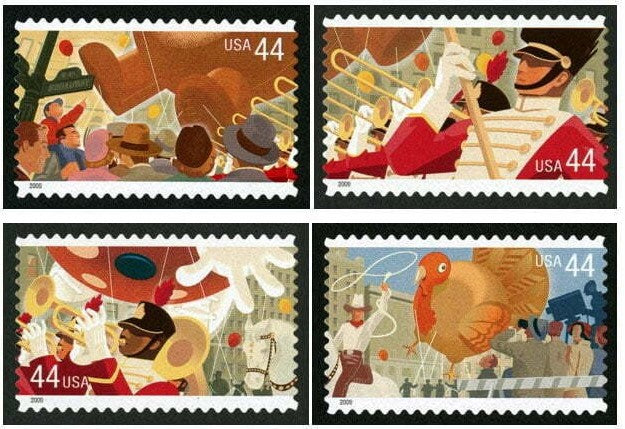
The USPS issued a Thanksgiving commemorative on 19 October 2001 — a stamp that has to carry four centuries of history in a square inch.
Harvest imagery is the usual solution: cornucopias, autumn produce, the visual shorthand for abundance. It is a sensible design choice, and it does compress a considerably more complicated story.
What the holiday commemorates
The Mayflower reached North America in 1620 carrying 102 passengers, many of them Separatists who had left England over religious persecution.
The winter that followed was catastrophic. Roughly 50 of them survived it — around half.
They survived at all because of the Wampanoag, who brought supplies and taught them to hunt, fish, and grow corn and squash in ground they did not understand. The harvest celebration the holiday derives from was the settlers marking that first successful harvest, with their Wampanoag neighbours present.
The gathering lasted three days, with shooting, games, running and wrestling alongside the meal — closer to a festival than to a dinner.
How the date got fixed
For most of American history there was no fixed date. Individual states set their own, which meant the holiday moved around and sometimes did not happen at all.
It was settled on the fourth Thursday of November and made a national holiday in 1941 — recently enough that people alive today remember it being unsettled.
The food and the games
Roast turkey is the fixed point, usually stuffed and served whole to be carved at the table. Around it: sweet potato, pumpkin pie, cranberry sauce.
The games are the part that survives least well in descriptions and best in practice. The wishbone is pulled by two people making wishes, and the longer piece wins. Pumpkin races are run pushing a pumpkin with a spoon and no hands — the smaller the spoon, the better the game.
Buying Thanksgiving and autumn stamps
Two practical points.
Autumn designs sell out before the season does. Harvest, foliage and Thanksgiving issues are printed for one year and are gone by mid-November. Buy in September or early October, or buy a retired design from a surplus channel.
Cards are lighter than you think, and postcards are cheaper. A short seasonal greeting on a postcard costs noticeably less than the same message in an envelope, and for a large family list that adds up.
If a specific year's design matters to you, the secondary market is where it lives once the season passes — and it remains valid postage regardless of its issue year.
Where to buy
The USPS official store for current seasonal issues, or a verified surplus channel such as Forever Stamp Center for retired autumn and holiday designs.
The short version
The 2001 stamp commemorates a harvest that happened because the Wampanoag taught fifty surviving settlers how to farm unfamiliar ground. The date was only fixed in 1941 — and the seasonal stamps sell out in October.
More on buying Forever stamps
- 👉 Veterans Day Was Armistice Day Until a Kansas Town Renamed It
- 👉 Media Mail Closes First: The Deadline Nobody Watches
- 👉 Funny Halloween Stamps: The Classic Sets

USPS specialist based in Los Angeles with extensive experience in postal operations and customer service. Certified in mail management and trained at the USPS Business Mail Academy, she offers reliable guidance on Forever Stamps and practical mailing solutions.
