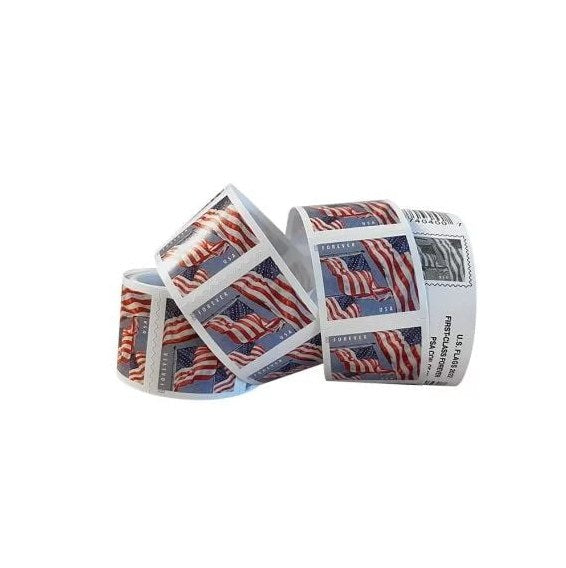
In early November 2011, the USPS announced that all commemorative stamps for that year would be issued as Forever stamps — no printed denomination, valid for first-class postage regardless of future rates.
It sounds administrative. It changed what a commemorative stamp is.
Why it mattered
Before the change, a commemorative carried a printed face value. When rates rose, the stamp was still valid — for the amount printed on it, which was now less than a letter cost. Sheets bought and kept became fractionally useful rather than usable.
Making them Forever issues removed that entirely. A commemorative bought for its design can be used years later without arithmetic, which is convenient for the buyer and removes a real burden from the postal service: every rate change previously required printing large quantities of small make-up denominations.
It is a genuinely win-win administrative decision, which is rare enough to note, and the approach has become routine in postal services elsewhere.
The rate case that ran alongside it
The context was financial pressure. The USPS had proposed raising the first-class rate from 44 to 46 cents, and the Postal Regulatory Commission rejected the proposal on 30 September. The Postal Service appealed.
That sequence is worth remembering whenever someone predicts a specific future stamp price: proposals go through an independent regulator, and the regulator says no often enough to make forecasts unreliable.
The 1983 World Communications Year issue
One commemorative that missed the Forever change by decades is worth mentioning for what it was.
On 19 November 1981 the UN General Assembly adopted a resolution proclaiming 1983 as World Communications Year, and postal services around the world issued stamps to mark it.
The designs were built around the year's emblem — rotating, crisscrossing lines representing circuits distributed across the globe. The US version used roads and circuits reaching outward, in blue and yellow.
The point of the programme was practical rather than ceremonial: member states used the year to argue for investment in postal and telecommunications infrastructure, and the stamps were part of making that case publicly.
What this means if you are buying
Commemoratives issued from 2011 onward are Forever stamps and remain usable postage indefinitely, whatever their design year. Earlier commemoratives are denominated — a stamp from 1983 covers only the value printed on it, not a current letter.
So an older commemorative found in a drawer is a collectible; a 2011-or-later one is both a collectible and a stamp you can put on an envelope today.
Best deals on Forever stamps
Retired Forever commemoratives are the useful overlap: they carry designs no longer sold, they cost less than current issues through surplus channels, and they are full postage value.
Where to buy
The USPS official store for current issues, or a verified surplus channel such as Forever Stamp Center for the wider range of retired designs.
The short version
From 2011 US commemoratives have been Forever stamps, so a design bought for its picture is still a usable letter years later. Anything older is denominated and worth only what is printed on it.
More on buying Forever stamps
- 👉 Global Forever Stamps and World Stamps Are Different
- 👉 How to Get a Stamp Off an Envelope Without Ruining It
- 👉 The First Winter Olympics Stamp

Retired USPS mailroom supervisor with 30 years of service in Chicago. He now contributes columns on Forever Stamps, sharing trusted advice on spotting counterfeit risks and finding reliable discount deals for everyday mailers.
