Search for advice on identifying counterfeit postage and two suggestions come up constantly. Check the watermark. Check for the padlock in the address bar.
Neither one works. Both are worth understanding, because believing them makes you more confident about a purchase without making you any safer.
The watermark test
Hold the stamp up to the light, look for the watermark, compare it against a known-good one. Sound advice — for stamps from countries that watermark their paper.
The United States stopped watermarking postage paper more than a century ago. A modern US stamp has no watermark to check. So the test returns "no watermark found" on the genuine article and on the forgery alike, and if you interpret that as a red flag you will reject real stamps; if you interpret it as normal you have learned nothing.
It is not a slightly weak test. It is a test with no signal in it at all.
The padlock test
Click the padlock, confirm the connection is secure, conclude the seller is legitimate.
The padlock means traffic between your browser and that server is encrypted. That is all it means. Certificates are free and automatic now, so a fraudulent site has one for the same reason a real one does — it takes no effort to obtain and looks identical.
Encryption protects your data in transit from third parties. It says nothing whatsoever about who is at the other end.
What actually works
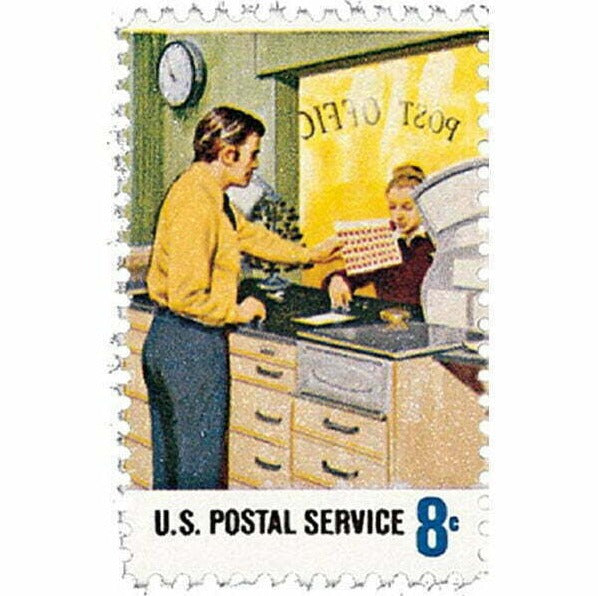
The edges. This is the strongest physical test. Genuine coil stamps are produced on government presses and carry characteristic printing grooves; the die-cutting or perforation is consistent down the roll. Counterfeits are frequently trimmed after printing — an edge that shows the mark of scissors, a razor or a paper cutter is not a stamp that came off a postal press.
Colour. Fakes run off. Unusual saturation, an odd sheen, colour that varies between stamps that should be identical. Set a suspect sheet beside a known-good one under the same light and the difference is usually immediate.
Print quality at magnification. Counterfeiters cut corners in the fine detail because that is where the cost is. Photograph both stamps and enlarge them to full screen — microprinting, the crispness of line work, the register between colours. This is where a fake that passes at arm's length falls apart.
Uneven or rough surfaces. Broken edges, a gummed side that feels wrong, paper that behaves differently in a stack.
Which issues get counterfeited
Flag stamps most of all, because they sell in the highest volume. But commemoratives get copied too — Love Skywriting from 2017, Hot Wheels from 2018, Cactus Flowers from 2019 and Winter Scenes from 2020 have all been reported as counterfeited.
The Postal Inspection Service issued a nationwide advisory on 17 December warning that counterfeit postage sold online had escalated, and asking buyers to be aware of it so that their mail arrives without delay. That last part is the real cost: postage due, or a returned letter, arriving after whatever you sent it for has passed.
The one test that scales
Everything above examines a stamp you have already bought. The test that works before you buy is about the seller.
USPIS advice is to buy from approved postal vendors — and it explicitly notes that these can include reputable wholesalers and warehouses that offer discounted stamps under resale agreements with the Postal Service. That is the legitimate discount channel, and it exists. What it does not include is an anonymous listing at a price nobody with a real supply agreement could offer.
So: can the seller tell you where the stock came from? Is the discount in the range a resale agreement could actually produce, or is it the kind of number that only works if the stamps are printed rather than bought? Those two questions do more than any amount of squinting at perforations.
The channels, honestly compared
USPS.com — no counterfeit risk, delivery in a few business days, and a narrow catalogue limited to what is currently in print. No discount, ever.
Marketplaces — the widest selection, and the widest price range: a booklet of 20 can run anywhere from $14 to $200 depending on whether it is being sold as postage or as a collectible. Also where most counterfeit reports originate.
Specialist resellers — retired designs, themed ranges and volume, at a real discount when the supply is real. Judge them on whether they can account for stock.
Best deals on Forever stamps
A genuine discount on Forever stamps is a modest one from a seller who can explain it. A large one from a seller who cannot is the single most reliable indicator of counterfeit postage there is — and unlike a watermark or a padlock, it is a signal you can actually read.
Where to buy
The USPS postal store, their list of authorised outlets, or a verified surplus channel such as Forever Stamp Center at www.foreverstampcenter.com. Read the Postal Inspection Service page on counterfeit stamps and AARP's reporting on the surge before buying from anyone new. Our own range starts at Forever stamps.
The short version
US stamps have no watermark, so that test tells you nothing. The padlock proves encryption, not honesty. Check the edges, the colour and the fine detail — and before any of that, check whether the seller can say where the stamps came from.
More on buying Forever stamps
- 👉 The Most Counterfeited Stamp in America Is the Flag
- 👉 Buying Forever Stamps in Bulk Online
- 👉 You Can No Longer Put Your Face on a US Stamp

USPS specialist based in Los Angeles with extensive experience in postal operations and customer service. Certified in mail management and trained at the USPS Business Mail Academy, she offers reliable guidance on Forever Stamps and practical mailing solutions.
