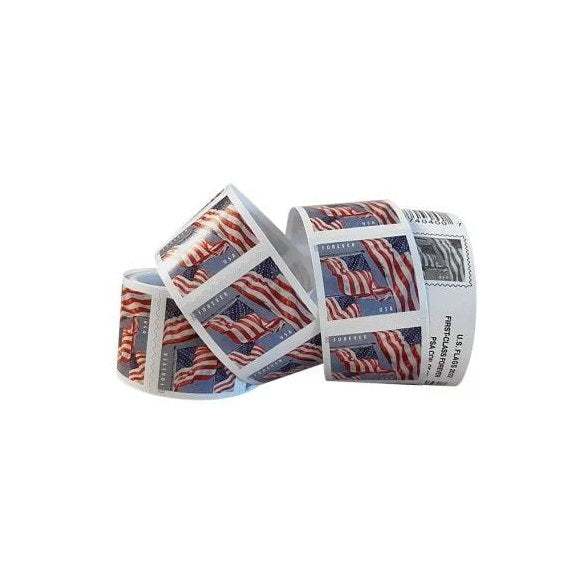
Forever stamps are usually explained as a favour to customers: buy now, beat the next increase. That is true, and it is half the story. The Postal Service had its own reasons, and they are more interesting.
What happened, and when
April 2007: the first Forever stamp, carrying the Liberty Bell. By 2011 essentially every one-ounce First-Class stamp had become a Forever stamp — the exceptions were bulk coils in rolls of 500, 3000 and 10000, which serve high-volume mailers who meter their own postage anyway.
That is a complete conversion of the retail product line inside four years. Nobody does that as a courtesy.
The customer's side
Straightforward. A Forever stamp is First-Class postage with no number printed on it. Buy at one rate, use at any later one, and every increase between the two is somebody else's problem.
Two things it does not do. A domestic Forever will not carry an international letter on its own — you have to add postage, which is why the Global Forever exists as a separate product. And the guarantee is about value, not condition: automatic sorting equipment rejects stamps that are torn, damaged, illegible or glued down, and a rejected stamp is a delayed letter regardless of what it is worth.
The Postal Service's side
Now the part that gets left out.
When you buy a stamp you have not yet used, USPS holds your money and owes you a delivery. Multiply that by every stamp sitting in every desk drawer in the country and it is a substantial sum held in advance of the service being performed. The structure is a membership fee paid up front — except nobody renews it, and nobody asks for it back.
There is a second effect. A stamp bought and never used is postage paid for a service never rendered. Lost stamps, forgotten books in a drawer, stamps that outlive the person who bought them. At the scale of a national mail system, that adds up.
And a third, which is the strategic one. The 2006 Postal Accountability and Enhancement Act changed the terms USPS operated under, tightening how it could set prices and pushing it to behave more competitively. Forever stamps arrived directly into that new environment. It removes the customer-facing friction of a rate increase — no scrambling for two-cent make-up stamps, no half-used books of obsolete postage — which makes each increase far less likely to drive someone away from mail altogether.
That is the real win. Not the float, and not the unredeemed stamps: the fact that raising the price stopped costing customers.
You can see the shift in the annual reports
The 2006 report is inward-looking — coordination, working together, everyone connected, doing the existing job well.
The 2007 report reads like a different organisation. It talks about a new law, a new era of accountability and competition, growth and innovation in the mailing industry, and adding value to the mail. The stated ambition is to be competitive and to respond to market conditions.
Forever stamps went on sale in April of that year. It is the first concrete product of that change in posture, and it looks like one.
Did it work
Total revenue went from $72,817 million in 2006 to $74,973 million in 2007. First-Class Mail revenue moved from $37,039 million to $37,564 million across the same period — modest, but rising in a category that had every structural reason to be falling.
By 2021, postal service revenue reached $77,009 million. (Sources frequently drop the unit on that figure; it is millions, like the others.)
First-Class letter volume has declined for years, so holding revenue at all in that category is not nothing.
The name
Worth a moment, because the naming is doing real work. "Forever" tells you the whole product in one word — no explanation, no asterisk, nothing to look up. Most people understand what a Forever stamp does before anyone tells them.
The one thing it slightly oversells: it is forever in value, not in physical durability. A Forever stamp that has been through a washing machine is worth exactly what any other ruined stamp is worth.
Best deals on Forever stamps
Understanding the mechanism tells you how to use it. The value is fixed at the rate on the day you mail, not the day you bought — so the only way to improve on it is to lower what you paid in the first place. That means buying below face on the surplus market, which is the one variable still under your control.
Where to buy
Current issues from USPS, at face value. Discounted retired stock from a verified surplus channel such as Forever Stamp Center — start with the Forever range. The figures above come from the USPS annual reports for 2006, 2007 and 2021.
The short version
Customers got protection from rate increases. USPS got prepaid revenue, a quantity of postage that will never be redeemed, and — most valuable of all — the ability to raise prices without the increase landing visibly on anyone.
More on buying Forever stamps
- 👉 A Letter Costs the Same to Cross the Street or the Country
- 👉 Every Global Forever Design, 2013 to 2022
- 👉 Two Popular Ways to Spot a Fake Stamp That Don't Work

USPS specialist based in Los Angeles with extensive experience in postal operations and customer service. Certified in mail management and trained at the USPS Business Mail Academy, she offers reliable guidance on Forever Stamps and practical mailing solutions.
