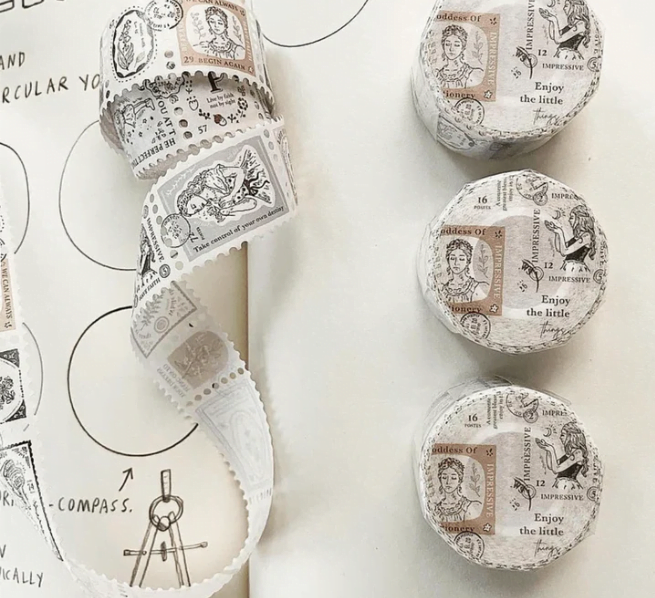
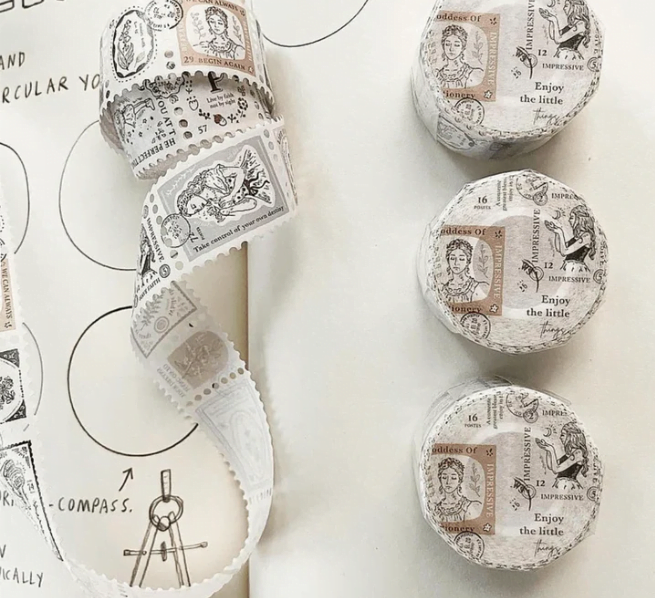
Pick up a stamp torn from a roll and one from a sheet, and the difference is in the edges. A sheet stamp has perforations on all four sides. A coil stamp has them on two sides only — the two where it joined its neighbours in the strip — and two smooth, straight edges where it never had a neighbour at all.
That single fact identifies a coil instantly, and it explains most of what follows.
Why coils exist
Vending machines. A machine cannot handle a sheet, but it can hold a long strip wound on a core and dispense a measured length of it.
The first machine selling stamps this way appeared at the World's Columbian Exposition in Chicago in 1893 — you put in coins, pressed for the value and quantity you wanted, and it dispensed the stamps and returned your change. (You will find this misdated to 1983 and misplaced to Britain in a number of write-ups; it was Chicago, and it was the Columbian Exposition.)
How they were made at first
Badly, and by hand. Before official production, whole sheets were torn into long strips, rolled up, and loaded into the machines. Some post offices punched holes at the joins so the strip would separate. The earliest coils were imperforate — no perforations at all, which made them awkward to tear and easy to damage.
Official US production began in 1906, though machines had been dispensing improvised strips since 1893. Properly perforated coils arrived in 1908, and that is the format still in use.
What a modern roll contains
A roll holds stamps of a single denomination — commonly anywhere from 100 up to 3000, with 500 to 3000 typical for high-volume users. The start of each roll carries a printed slip giving the count, denomination and type.
One detail worth knowing if you buy rolls: some carry a small counting number printed on the back of every fifth stamp. It is there so a clerk can check the count without unrolling the whole thing, and it is harmless — a back number does not affect validity.
Coils elsewhere
Canada, Germany, France, the United Kingdom and Sweden all adopted coils after the format took hold in the US. Japan issued them from 1933. More than twenty countries and territories use them now.
Sweden has issued the widest variety of coil designs; the US uses the greatest quantity by a distance.
US coils do not expire
A coil stamp from an old roll is valid postage — at its printed face value if it is denominated, or at the current rate if it is a Forever issue. This is not universal; plenty of countries demonetise old stamps. The US does not.
Which means an unopened roll found in a drawer is money, not memorabilia.
Where coils sit in US stamp history
A quick orientation, since coils arrive partway through:
From 1846 to 1847, individual postmasters issued their own provisional stamps, valid locally rather than nationally. National issues began in 1847 and through to 1865 tracked westward expansion and the Civil War. Presidents followed, and became the standing subject of definitives.
The decades between the Centennial and the First World War were dominated by exposition issues and presidential portraits — and it is into that period that the coil arrives, as a format rather than a subject.
Then 1917 to 1945, the span from one world war to the end of the next. From the 1930s the workhorse denominations were two and three cents.
Design stayed conservative until around the 1960s and opened up considerably after the 1970s. That later period is also when the specialist categories proliferate — semi-postals carrying a donation, airmail, special delivery, postage due, parcel post, newspaper stamps, and hunting permit stamps.
Flags, which is what most coils actually are
The first US stamp given over to the flag itself was issued on 4 July 1957 at four cents, showing the 48-star flag.
Then the map changed twice in one year. Alaska became the 49th state on 3 January 1959, and a four-cent 49-star flag stamp followed that Independence Day. Hawaii became the 50th state on 21 August 1959, and the four-cent stamp of 4 July 1960 was the first to show 50 stars.
Between 1957 and 2000 the US issued 46 flag stamps, and the great majority of them were coils. That is not a coincidence: coils go to the highest-volume mailers, and the flag is the design that offends nobody.
Best deals on Forever stamps
Rolls are where volume buying happens, and where the largest discounts on surplus stock appear — a full unopened coil is the cleanest thing to price, count and verify. Forever coils carry a letter at today's rate however long they have been sitting.
Where to buy
Current coils from USPS, in the standard roll sizes. Retired designs and surplus rolls from a verified surplus channel such as Forever Stamp Center — see the Forever range.
The short version
Two perforated edges and two straight ones means a coil. They exist because of vending machines, they were being improvised by hand before 1906, and they are the format flag stamps mostly ship in. Old US coils never expire.
More on buying Forever stamps
- 👉 The Most Counterfeited Stamp in America Is the Flag
- 👉 Two Popular Ways to Spot a Fake Stamp That Don't Work
- 👉 Before 1840, the Person Receiving the Letter Paid

USPS specialist based in Los Angeles with extensive experience in postal operations and customer service. Certified in mail management and trained at the USPS Business Mail Academy, she offers reliable guidance on Forever Stamps and practical mailing solutions.
